
Baker County Civil Docket Searches
For Baker Superior, begin at the Georgia E-Access directory. It points to a provider. That provider requires an account rather than offering one statewide public search. PeachCourt is named separately by the clerk as a civil e-filing route. Remember that filing a paper and reading the public docket are two different services. Filing credentials do not guarantee access to every image.
Superior records may not be online. Then call the Clerk of Superior & Juvenile Court at 229-734-3004 or visit 167 Baker Place during posted weekday hours. Mail requests go to P.O. Box 10, and a fax number and email address are published too. For small claims, dispossessory actions, and other Magistrate matters, use 229-734-3007. Probate estate and guardianship records share that lower-court office but sit on a distinct docket.
- Identify Superior, Magistrate, or Probate jurisdiction before searching.
- Use an exact case number when available, or the full legal party name.
- Open the event list and confirm county, court, filed date, and case type.
- Compare the newest event with the circuit calendar and filed notice.
- Request the specific judgment, order, or certified copy from its custodian.
PeachCourt and Baker E-Access
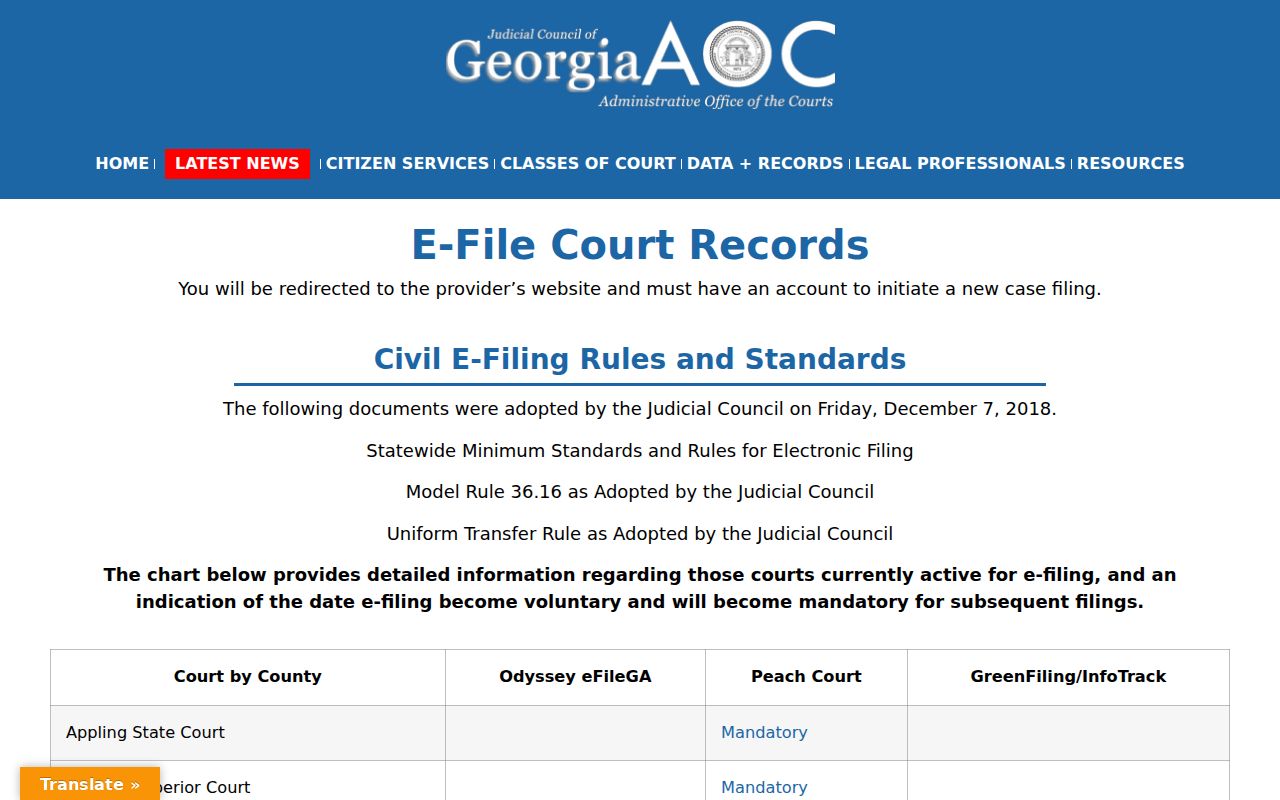
The local clerk e-filing notice names PeachCourt for Baker County civil cases. The state e-filing chart lists Odyssey eFileGA and PeachCourt as mandatory vendors for Baker Superior. GreenFiling/InfoTrack is also available. These routes move filings into the official court system. None of them is a free public docket. Treat them as transmission services rather than open case lookup tools.
The PeachCourt service interface is a second assigned image source.
The official chart supplies the third assigned visual.
Civil Dockets: What They Show
A Baker County civil court docket opens with a header. Then it walks through events in the order they happened. Labels vary by provider. Confirm exact wording inside the live account. In general, the docket separates a filed complaint or petition, service, an answer, motions, orders, and settings. Judgment and appeal activity follow in their own entries. Discovery exchanged between parties often stays off the docket entirely. That means the record is not a full history of every step outside court.
| Case style | The formal party caption, which should be checked before relying on a name match. |
|---|---|
| Case number | A court code; Baker calendar examples include 2026-A-002, 2023V-012A, and 2025V-033. |
| Filing and service | The opening paper and returns showing efforts to give formal notice. |
| Motion and order | A request and the judge’s separate written response; filing alone does not establish a result. |
| Disposition | A judgment, dismissal, settlement order, transfer, or other resolution. |
Numbers that differ in length are real calendar examples, not a format rule. Never pad or change a code to fit a pattern you like better.
Baker Civil Case Number Variations
Baker County publishes no official case-number syntax guide. Even so, circuit calendars show more than one pattern. The variation may reflect case class, year, older practice, or local system fields, but nothing official defines the reason. Copy the complete number exactly, including letters, hyphens, and any suffix.
Search pointer: When a number fails, confirm Baker County and the correct court before dropping a letter or suffix.
A party-name search can recover the case number. With common names, double-check the style, case type, court, and filing date before trusting a match. An account gate is only a provider's access rule. It does not mean the case itself is sealed.
What Cases Fill the Civil Docket
Divorce, domestic relations, equity, land title, and general civil cases belong to Superior Court. Magistrate Court takes civil claims up to $15,000 plus dispossessory cases. It holds no jury trials. Appeals go up to Superior Court. Probate Court keeps the estates, wills, and guardianship files. Sending a request to the wrong clerk will slow any search. The offices share the Baker Place complex.
| Matter | Starting court | Record contact |
|---|---|---|
| Major civil, equity, title, divorce | Baker Superior | 229-734-3004 |
| Claim up to $15,000 | Baker Magistrate | 229-734-3007 |
| Dispossessory | Baker Magistrate | 229-734-3007 |
| Estate or guardianship | Baker Probate | 229-734-3007 |
A Magistrate appeal can create a later Superior docket. When the lower-court file shows an appeal or transfer, search both levels.
Baker Civil Cases From Filing
A Baker civil case enters the docket when the complaint or petition is accepted. Service comes next, then an answer or counterclaim may frame the dispute. Motions ask the court for rulings. Much of discovery never touches the filed record at all. Later come hearing and trial settings. Judgment, dismissal, a settlement order, or another outcome follows. Enforcement and appeal entries can keep appearing even after judgment.
Civil flow: Complaint or petition → Service → Answer or counterclaim → Motions → Hearing or trial → Judgment → Enforcement or appeal.
A filed motion is not a granted motion. When the event list shows a motion with no order, read the later entries, open the signed order if an image exists, or ask the clerk for that exact document.
Hearings on the Civil Docket
Official circuit PDFs list the time, sequence number, case style, and case number. Matter type, attorney or pro se status, and notes also appear. Judge M. Claire Chason’s 2025 assignment covers Baker, Calhoun, and Grady civil matters. A later order or conflict can control instead. A Baker civil hearing may take place outside Newton. File custody and hearing location are not always the same.
The Baker and Calhoun civil hearing sample from the circuit includes a separate grouping for removed or rescheduled matters. That section alone explains why the newest notice beats an old setting line every time.
- Setting
- A scheduled court event, not necessarily the trial.
- Removed
- A matter taken off that calendar; read later entries for what followed.
- Rescheduled
- A setting moved to another date, which the newest notice should identify.
- Pro se
- A party appearing without a lawyer.
Baker Civil Reporter Gap
One circuit notice changes the math for Baker County civil hearings. Monthly civil dates will have no designated reporter after September 1, 2025. A party who wants a verbatim record must now procure a reporter on its own. That gap matters when you read a Baker County court docket. The docket can prove a hearing was scheduled or held. Yet it cannot create the words that were spoken.
So check the hearing date first, then ask whether a reporter actually attended. If nobody did, a transcript may not exist at all. The written order entered afterward is a different animal. You can still request it from the clerk. Since an order is the court’s ruling, it is often the more useful record anyway.
Who Can See Civil Dockets
Access to Baker County civil dockets leans open. Uniform Superior Court Rule 21 favors public inspection. A statute or a supported court order must say otherwise before anything is closed. Two further protections apply: Rule 21.6 and O.C.G.A. § 9-11-7.1 shield specified personal identifiers. Juvenile, adoption, sealed family, and protected-order material may be missing or masked. The Georgia Open Records Act backs broad public access too. Still, civil case-file requests should go to the judicial custodian rather than elsewhere.
Copy fees follow the local clerk’s published schedule. Certified or exemplified Superior copies run $2.50 for the first page, then 50 cents each. Self-service plain copies cost 50 cents per page. Assisted copies run $1. Faxed or electronic copies cost $2.50 for the first page plus $1 later. The $199 general civil filing fee and the $50 sheriff service charge are filing costs. They are not docket search fees.
Access rule: A public event entry may be visible while its document image is unavailable, redacted, or restricted. Request the filed order from the clerk when its full terms matter.
Baker Civil Records Offline
Most Baker County Superior civil records still move through the clerk counter. Give a case number or a party name. The clerk can identify the case, let you inspect the public portions, and hand over paper, electronic, faxed, certified, or exemplified copies. Mail, phone, fax, email, and a general web inquiry form serve as fallback channels. Ask whether a public terminal exists; local sources do not promise one. They also publish no image charges or coverage years. Nor do they list search limits, turnaround times, or accepted payment types.
For a formal request, name the exact record you want. It might be the docket sheet, a final judgment entered on a known date, or an order on a named motion. Request a page count and a quote. A vendor download is handy for reference. It is not automatically the court’s certified record, though.